How to play Trickshot
One course a day, one ball, one hoop, and a few things in the way. Here is how to aim, what every gimmick does to the ball, and why par is what it is.
The rules in thirty seconds
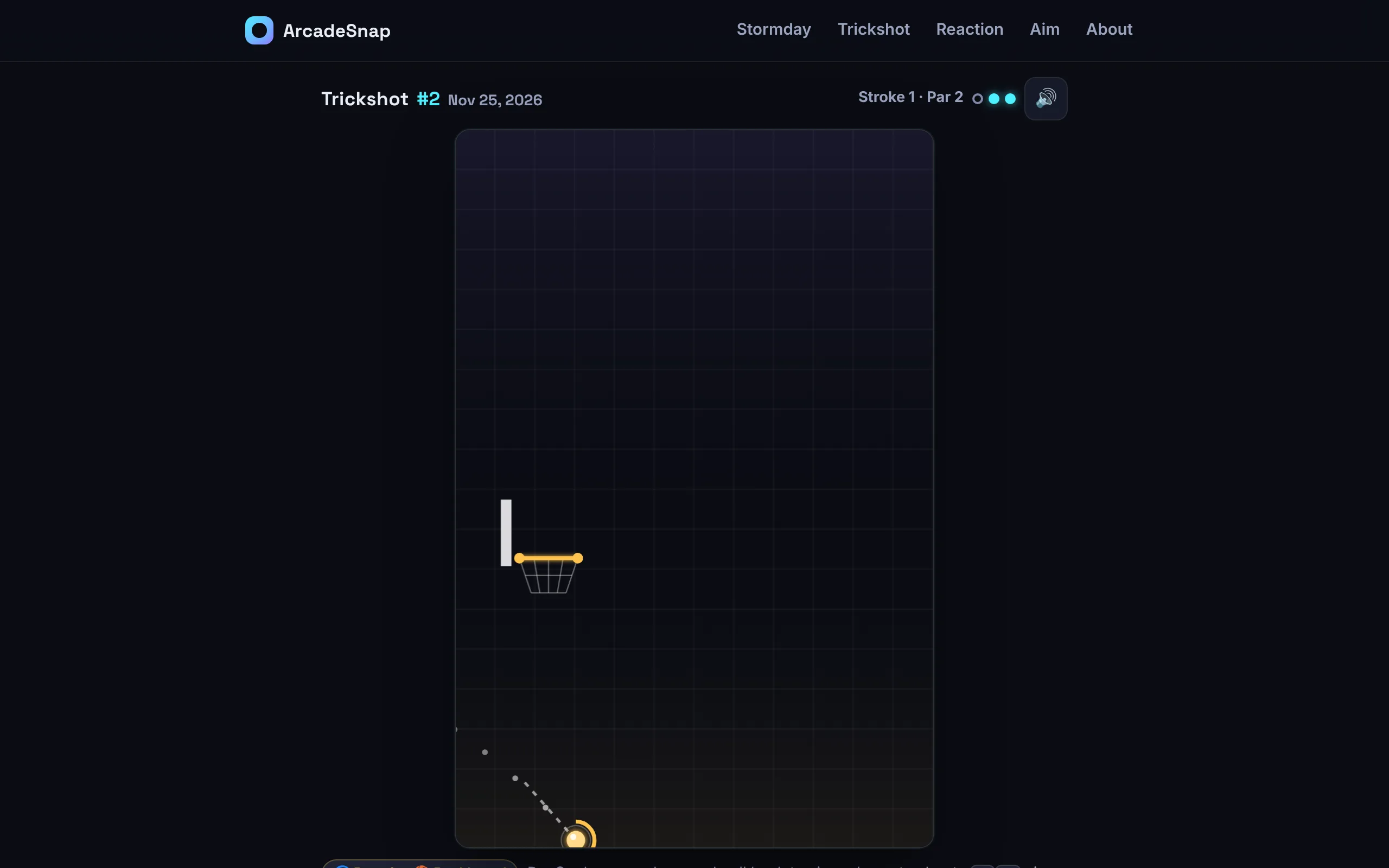
- The ball starts on the tee (the faint ring near the floor). Get it through the amber hoop, from above, in as few strokes as possible.
- A stroke ends when the ball comes to rest. Your next stroke starts from wherever it stopped. Ten strokes without sinking it is a DNF.
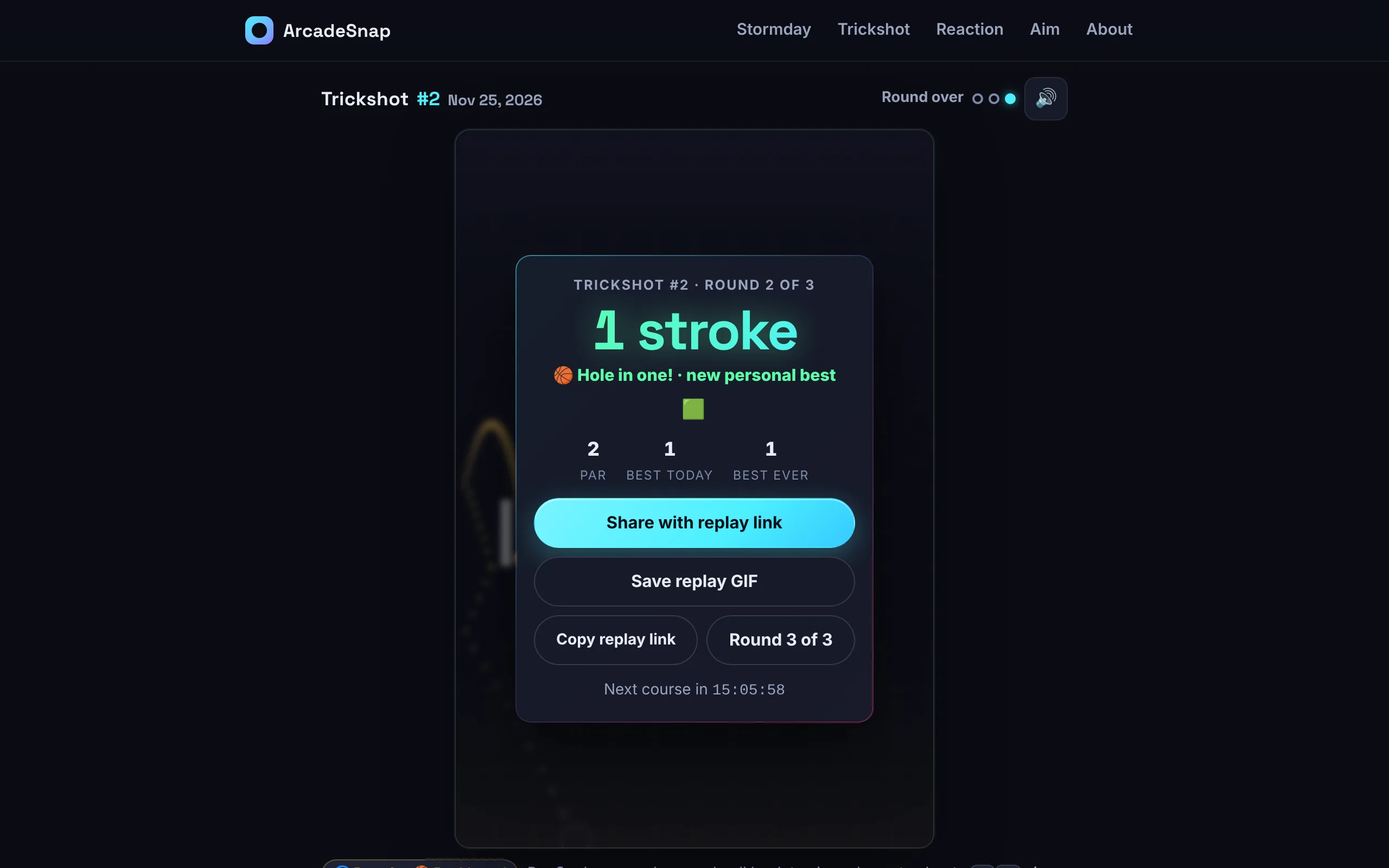
- You get three official rounds a day. Your best round is your result. After that, practice as much as you like.
- Every course is the same for everyone and can be made in one stroke. Par is 2 when the one-stroke window is wide, 3 when it is narrow.
Aiming
| Input | How | Notes |
|---|---|---|
| Mouse / touch | Press anywhere on the course, pull back from the direction you want to shoot, release. | You do not have to touch the ball. A pull of about 200 pixels is full power; less than a ball-width cancels. |
| Keyboard | ← → rotate, ↑ ↓ power, Space shoots. | Hold Shift for 3× faster adjustment. Your aim is remembered between strokes. |
Two things worth knowing about the aim indicator. First, the preview is a pure parabola: it ignores gimmicks and walls on purpose, so reading the course is still your job. Second, aim is quantized to 0.1 degree and 1,024 power steps, and the shot you fire is the quantized one. That is what lets your friend's browser reproduce it exactly from a short code.
The physics, in numbers
- Gravity pulls at 820 pixels per second squared. Full power is 1,050 px/s, minimum 260.
- Walls, the floor and grey blocks return 58% of the ball's speed and shave 10% off the sliding component. Three bounces and most of the energy is gone.
- Bounce pads return 118%, and never spit the ball out slower than 420 px/s. They are the only way to gain energy mid-flight.
- The hoop opening is 44 pixels wide; the ball is 14. A shot counts when the ball's centre crosses the rim line going down. Rims are solid little posts and will bounce you.
- Air drag is tiny (0.05% per step) and mostly there so nothing orbits a gravity well forever.
Every gimmick and how to use it
- 🧱 Blocks. Platforms and pillars. A ball resting on a platform shoots from there next stroke, which is sometimes the plan: lay up onto a ledge above the hoop, then drop in.
- 🟩 Bounce pad. On the floor or a wall. Hit it hard and the ball leaves faster than it arrived. Floor pads turn a downward shot into a lob; wall pads turn a flat shot into a bank.
- 🌀 Portals. Two dashed rings. Entering one puts you at the other with the same velocity. The exit is usually higher than the entrance, so a low, fast shot into the lower ring becomes a high, fast shot out of the upper one. There is a quarter-second cooldown, so you cannot ping-pong.
- 🌬️ Wind. A translucent band with arrows. While the ball is inside it is pushed sideways at 260–460 px/s². Slow balls get carried a long way; fast balls barely notice. Aim upwind of the hoop by about a hoop-width for a medium shot.
- 🪐 Gravity well. Pulls toward itself, strongest up close (capped so it cannot trap you). A shot that passes to one side of the well bends around it; a shot straight at it gets slingshot through. Treat it as a curve you can borrow.
- ↔️ Moving hoop. Slides left and right on a fixed rhythm that restarts the moment you shoot. While you aim, the solid hoop sits where it will be at the instant of the shot and a faint ghost loops through the motion it will make afterwards, labelled with the seconds since the shot. Match your ball's hang time to the ghost.
- 🏀 Backboard. A white board beside the hoop. Bank shots off it drop almost vertically into the net, which is far more forgiving than a direct swish.
- ⬛ Lid. A block 70–100 pixels above the hoop. Lobs are dead; come in low from the side, or bounce up from the floor underneath.
Reading a course in ten seconds
- Find the hoop and the lid. If there is a lid, you already know the ball must arrive sideways.
- Draw the lazy arc. Imagine the plain parabola from tee to hoop. Does anything sit on it? Blocks mean a bank or a lay-up; wind means an offset; a well means a curve.
- Look for free energy. Pads and portals usually point at the intended trick. The generator rejects courses where a plain lob is the whole answer, so if you see a pad, it is probably load-bearing.
- Shoot medium, not maximum. Full-power shots bounce around for seconds and end somewhere random. Three-quarter power is controllable.
- Use the miss. A miss that rests on a platform near the hoop is often a better second shot than the tee was. Lay-ups are part of the game.
Replays
After a round the share text contains a link such as arcadesnap.com/trickshot/2026-12-01?r=1ku9Q. The letters after r= are your strokes: 22 bits each, packed into base-64. Opening the link rebuilds that day's course, replays each stroke through the same physics, and then offers the course to play. Nothing is uploaded and there is no account; the link is the whole replay. The Save replay GIF button renders the same thing to an animated image, at 12 frames per second, entirely in your browser.
Frequently asked
Is every course really solvable?
Yes. Before a layout is accepted, the generator fires 864 sample shots from the tee through the real physics and requires at least two of them to go in. If fewer do, or if too many plain lobs go in, it throws the layout away and tries again. Details in the devlog.
The ball got stuck between a block and the wall.
Strokes end automatically after nine seconds, and you shoot from wherever the ball is. Shooting straight up or down is allowed, so you can always get out.
Does a moving hoop break replays?
No. The hoop's position depends only on time since the stroke began, which is the same in every replay.
Can I play yesterday's course?
Every day since launch is in the archive, in practice mode.